

Bulgaria adopts the euro
Prepared by Matteo Falagiarda, Christine Gartner and Steffen Osterloh
Published as part of the ECB Economic Bulletin, Issue 8/2025.
On 1 January 2026 Bulgaria adopted the euro and became the 21st member of the euro area. The assessments set out in the latest convergence reports of the European Commission (2025) and the European Central Bank (ECB, 2025) paved the way for Bulgaria to adopt the euro and thereby further enlargement of the euro area following Croatia joining in 2023.[1] On 8 July 2025 the Council of the European Union formally approved the accession of Bulgaria to the euro area and determined a Bulgarian lev conversion rate of 1.95583 levs per euro. This rate had been the central rate of the lev during the country’s participation in the exchange rate mechanism (ERM II).[2] Bulgaria’s adoption of the euro demonstrates that euro area membership remains an attractive prospect in times of high uncertainty and geopolitical tensions.
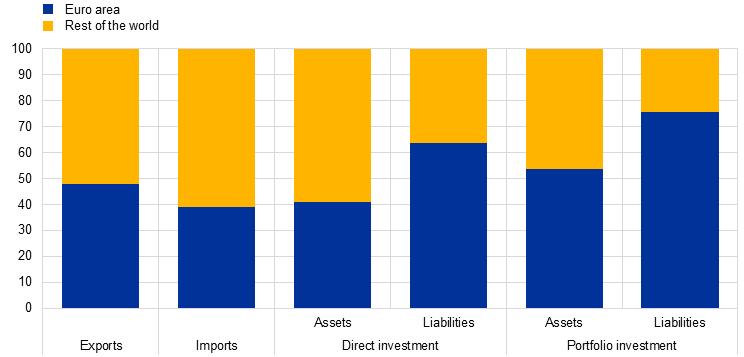
Bulgaria is well integrated with the euro area through trade and financial linkages. The country has a population of about 6.5 million and its GDP accounts for around 0.7% of euro area GDP. Its economic structure is broadly similar to that of the euro area as a whole, with industry (including construction) and services contributing around 29% and 68% respectively to gross value added, compared with around 26% and 72% in the euro area. The euro area is Bulgaria’s main trading and financial partner (Chart A, panel a). Prior to adopting the euro, its economy showed a relatively high degree of euroisation. Around 70% of government debt, along with a significant share of the debt of non-financial corporations, was already denominated in euro, mirroring the currency composition of both household savings and firms’ liquid assets, which are largely held in the form of deposits (Chart A, panel b). For over 25 years Bulgaria’s monetary policy was aligned with that of the ECB through its currency board, which maintained a fixed BGN/EUR exchange rate. Bulgaria’s deep integration with the euro area is reflected in the strong alignment of its business cycle with that of the euro area in the 15 years before euro adoption. Furthermore, banks owned by financial institutions domiciled in other euro area countries play a dominant role in the Bulgarian banking system.
Chart A
Bulgaria’s linkages with the euro area
a) Trade and financial linkages
(as a percentage of the total)
b) Share of euro-denominated government debt, loans and deposits
(as a percentage of the total)
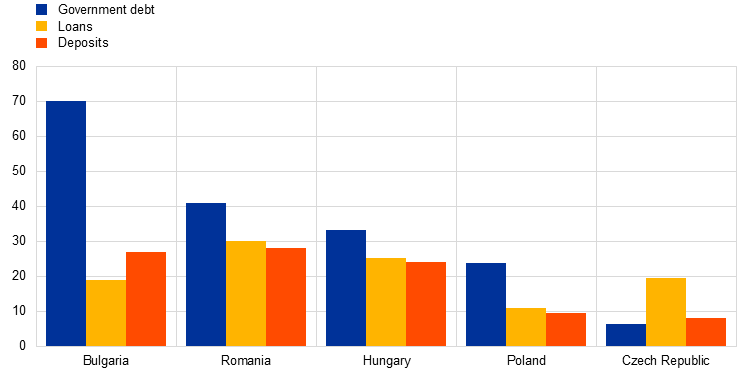
Sources: ECB and ECB staff calculations.
Notes: Panel a): the data are for 2024. Exports and imports refer to trade in goods only. Panel b): the data refer to outstanding amounts of loans to and deposits of domestic private sectors (other than monetary financial institutions) at the end of October 2025, and to the stock of general government debt at the end of 2024.
As with other countries that have adopted the euro, Bulgaria is expected to benefit from lower transaction and borrowing costs. Given Bulgaria’s deep integration with the euro area and its commitment to maintaining sound fiscal, structural and financial policies, adopting the euro is expected to bring with it a number of economic advantages. These include: (i) increased foreign trade and investment driven by lower transaction costs; (ii) enhanced price transparency and comparability; and (iii) greater investor confidence.[3] The economy is also expected to gain from lower borrowing costs due to well-anchored inflation expectations and reduced regulatory costs for banks, such as lower reserve requirements. Furthermore, Bulgaria’s euro adoption allows it to participate in the euro area’s decision-making and shape relevant economic policies.
The costs and risks of adopting the euro are expected to be minor and largely one-off. When it comes to a country joining the euro area, the main sources of concern are the costs of the changeover and the potential for unjustified price increases when prices are converted to euro.[4] To allay these concerns, the Bulgarian authorities have implemented several measures, including enhanced price monitoring and inspections to address abusive practices, as well as a long mandatory period for the dual display of prices, which began on 8 August 2025 and will end on 8 August 2026. Nevertheless, public support for the euro in Bulgaria remains relatively low amid fears of price hikes. This was also the case for previous euro changeovers, with support then typically rising thereafter (Chart B).[5] Considering Bulgaria’s high level of economic and financial integration with the euro area and its long-standing fixed BGN/EUR exchange rate, the loss of exchange rate flexibility as a stabilisation tool is practically inconsequential.
Chart B
Attitudes towards the euro
(as a percentage of the total)
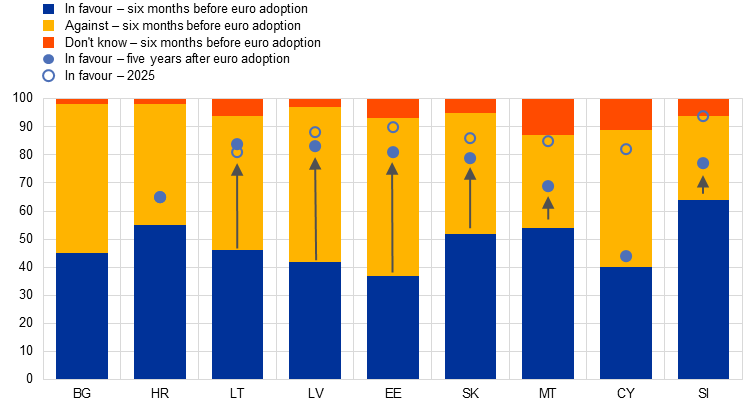
Source: European Commission (Eurobarometer).
Notes: The bars show responses to the question “Generally speaking, are you personally more in favour or against the idea of introducing the euro in your country?” in the Eurobarometer survey entitled “Introduction of the euro in the Member States that have not yet adopted the common currency”. Full dots show responses to the question “Are you more in favour or against a European economic and monetary union with one single currency, the euro?” in the Standard Autumn Eurobarometer (Spring 2025 for Croatia). Empty dots show responses to the same question in the Standard Spring Eurobarometer 2025.
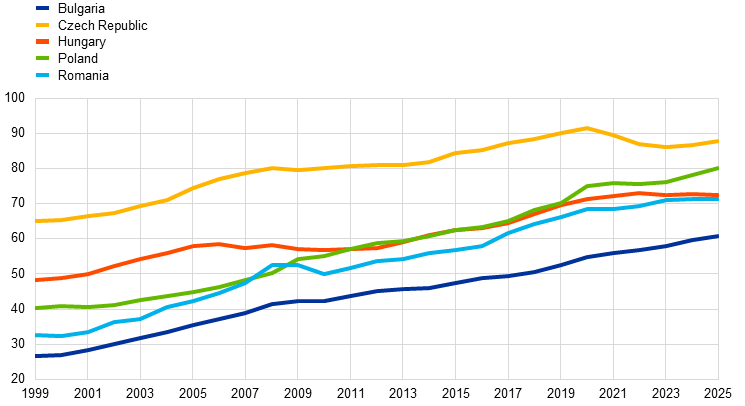
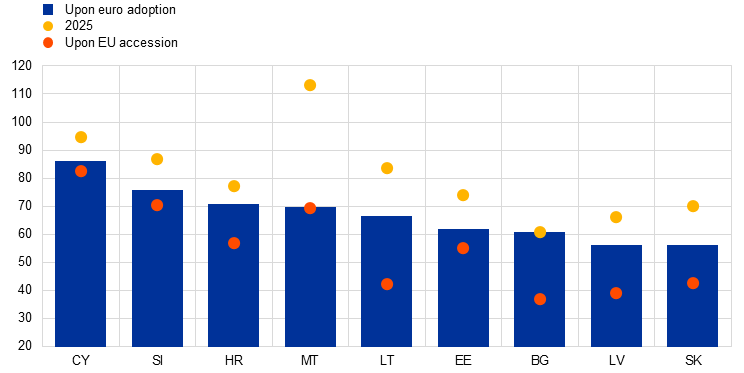
Since joining the EU in 2007, Bulgaria has made significant progress in converging towards the euro area. The excessive macroeconomic imbalances in existence before the COVID-19 pandemic – such as a negative external position, fragilities in the financial sector and high corporate indebtedness – have gradually been corrected with credible policy actions and prudent fiscal policies. Bulgaria has also made notable progress in terms of convergence in real terms: GDP per capita rose from around 35% of the euro area average in 2006 to just above 60% in 2025 (Chart C, panel a). Furthermore, it has achieved greater financial integration, with the close cooperation framework (established in 2020) helping to both align supervisory standards with those of the euro area and strengthen financial stability.
While Bulgaria’s economy has weathered recent shocks relatively well, risks to inflation convergence remain. The Bulgarian economy proved resilient throughout the pandemic and in the face of recent energy price spikes and geopolitical tensions. Nevertheless, its small and open nature means that it remains exposed to external shocks.[6] Inflation remains vulnerable to external price fluctuations owing to the high energy intensity of production and the large share of energy and food in household consumption.[7] Strong wage and credit dynamics – though moderating – pose additional upside risks. Over the long term, Bulgaria’s relatively low income and price levels, when compared with other countries that have adopted the euro (Chart C, panel b), suggest that real and nominal convergence will likely continue.
Chart C
Real GDP per capita relative to the euro area average
a) Evolution over time and compared with regional peers
(index: euro area = 100)
b) Compared with other countries that have adopted the euro
(index: euro area = 100)
Sources: European Commission (AMECO database) and ECB staff calculations.
Notes: Real GDP per capita is expressed in purchasing power units. The data for 2025 are taken from the European Commission’s Autumn 2025 Economic Forecast. Panel b): the blue bars show real GDP per capita in the year preceding euro adoption (e.g. 2007 for Cyprus; 2025 for Bulgaria) relative to the euro area (EA20) average. The red dots show real GDP per capita in the year preceding EU accession (e.g. 2003 for Cyprus; 2006 for Bulgaria) relative to the EA20 average, while the yellow dots show the estimated level for 2025 relative to the EA20 average.
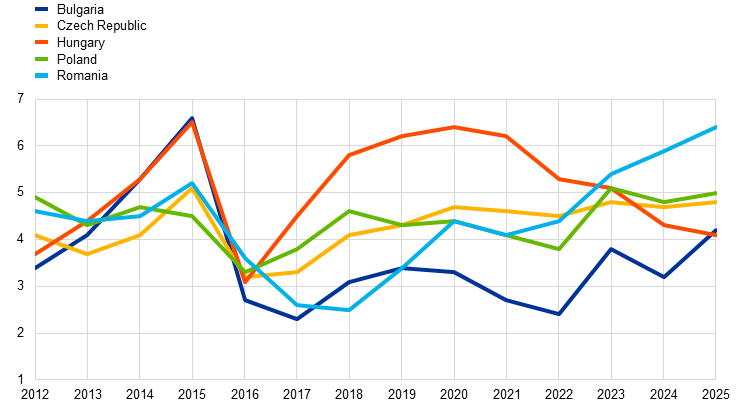
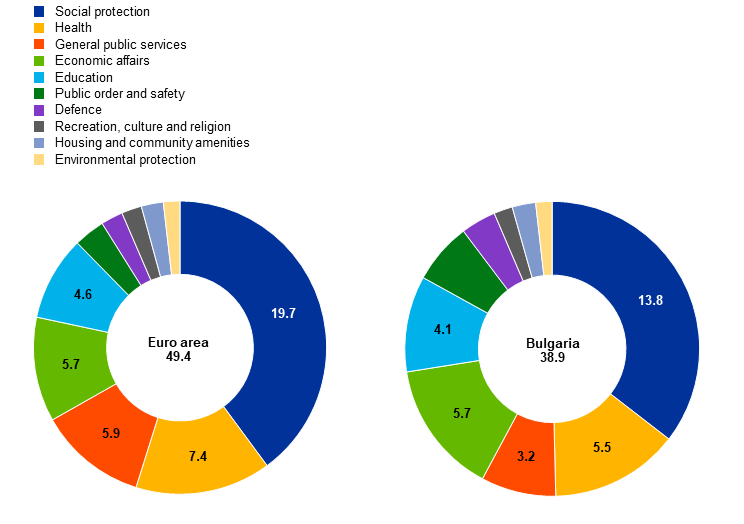
Bulgaria has maintained a sound fiscal record, but may face pressure to raise its relatively low levels of public expenditure. Under the currency board, the country recorded fiscal surpluses in 13 of the past 27 years, kept its debt ratio well below 60% of GDP (23.8% in 2024, the second lowest in the EU) and, from 2012, avoided being subject to an excessive deficit procedure. This strong fiscal performance was supported by prudent fiscal policy, which was required to sustain the credibility of the currency board. As Bulgaria adopts the euro and the constraints of the currency board fade, fiscal policy incentives may change. Should the perception emerge that fiscal discipline could become less strict, this could, over time, generate spending pressure, particularly for those economic functions for which the share of spending is currently relatively low. Notably, this is the case with public investment, which has remained persistently low compared with other CEE countries (Chart D, panel a), partly owing to the slower than initially planned deployment of Next Generation EU funds. Spending on social protection, health and education is also subdued compared with that in the euro area (Chart D, panel b). Should pressure to raise such government outlays transpose into increased expenditure, keeping the debt ratio stable would require higher tax revenues. Going forward, maintaining sound and growth-friendly public finances in line with the EU economic governance rules and supported by a strong national fiscal framework, together with continued structural reforms to bolster productivity, would be the best approach to achieving sustainable long-term economic convergence and avoiding undue inflationary pressures and losses of competitiveness that could hamper Bulgaria’s long-term economic growth potential.
Chart D
Public investment and expenditure
a) Public investment
(as a percentage of GDP)
b) General government expenditure, by economic function
(as a percentage of GDP)
Sources: European Commission (AMECO database), Eurostat (COFOG) and ECB staff calculations.
Notes: Panel a): the data for 2025 are taken from the European Commission’s Autumn 2025 Economic Forecast. Panel b): the data are for 2023. The numbers shown in the white circles indicate the total.
References
Bijsterbosch, M., Falagiarda, M. and Žídeková, L. (2025), “From headlines to hard data: mapping the uneven impact of geopolitical risk in Europe”, The ECB Blog, ECB, 28 November.
Dorrucci, E., Fidora, M., Gartner, C. and Zumer, T. (2020), “The European exchange rate mechanism (ERM II) as a preparatory phase on the path towards euro adoption – the cases of Bulgaria and Croatia”, Economic Bulletin, Issue 8, ECB.
Dreher, F. and Hernborg, N. (2025), “Love at second sight: support for the euro before and after adoption”, The ECB Blog, ECB, 4 November.
European Central Bank (ECB) (2025), Convergence Report, ECB, June.
European Commission (2025), “Convergence Report 2025 on Bulgaria”, European Economy Institutional Papers, No 320, European Commission, 4 June.
Falagiarda, M. (2024), “Inflation in the eastern euro area: reasons and risks”, The ECB Blog, ECB, 10 January.
Falagiarda, M. and Gartner, C. (2022), “Croatia adopts the euro”, Economic Bulletin, Issue 8, ECB.
Falagiarda, M., Gartner, C., Mužić, I. and Pufnik, A. (2023), “Has the euro changeover really caused extra inflation in Croatia?”, The ECB Blog, ECB, 7 March.
Legal Disclaimer:
EIN Presswire provides this news content "as is" without warranty of any kind. We do not accept any responsibility or liability for the accuracy, content, images, videos, licenses, completeness, legality, or reliability of the information contained in this article. If you have any complaints or copyright issues related to this article, kindly contact the author above.
